
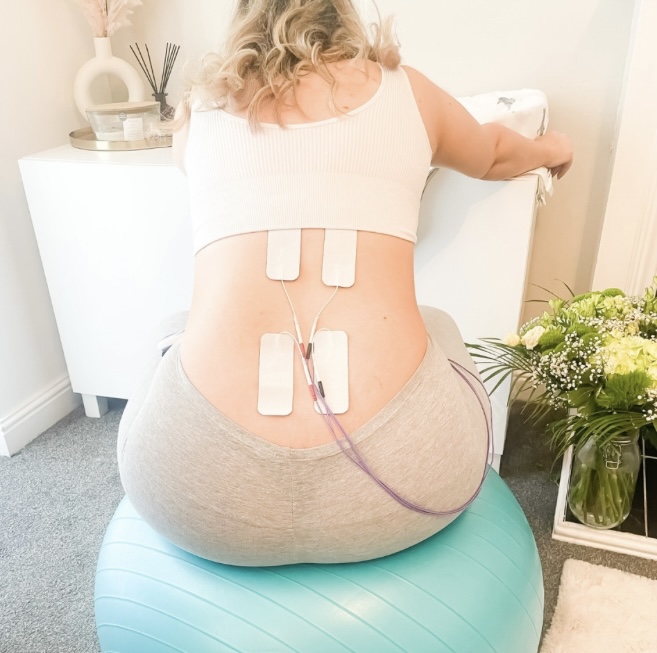
As a birth doula serving families across Greater Vancouver, I’m always looking for tools that can help my clients feel comfort and relief in labour. TENS is one of the most effective, research-backed comfort measures I use with my clients. TENS stands for Transcutaneous Electrical Nerve Stimulation. It’s safe, non-invasive, and gives the birthing person a powerful sense of agency over their labour sensations. It can help with staying mobile and clear-headed, in delaying or avoiding an epidural, and it is compact and easy to use.
Below is a comprehensive guide to how TENS works, why so many people choose it, and what you need to know before using it.

What Is a TENS Unit?
A TENS unit is a small, battery-operated device that sends mild electrical impulses through adhesive pads placed on the lower back. These impulses stimulate specific nerve pathways that can reduce how intensely pain is perceived.
TENS has been used since the 60s and is widely offered in the U.K., Canada, and Australia as part of standard labour comfort options. Many people rent or borrow units to use at home in early labour and continue using them as they move to their birth location.
How TENS Works: The Gate Control Theory of Pain
The Gate Control Theory describes the physiological mechanism that allows TENS to provide pain relief. Your spinal cord acts like a gatekeeper. Before pain signals reach the brain, they pass through “gates” in the spinal cord that regulate which sensations are allowed through.
Fast sensations compete with pain signals. Touch, pressure, and vibration signals travel along fast nerve fibres, while pain signals move more slowly. When the fast pathways are stimulated first, they can partially “close the gate” to incoming pain messages. TENS stimulates those fast nerve fibres. The gentle electrical pulses of the TENS unit activate fast, non-painful nerve pathways in the lower back. When these sensations reach the spinal cord ahead of contraction-related pain, fewer pain signals get through.
Your brain focuses on the pleasant tingling instead of the intensity of contractions. This doesn’t remove contractions, but it often decreases how sharply they are felt, especially in cases of back labour. TENS may also support endorphin release. Some research suggests TENS may help the body increase its own natural pain-relief chemicals, further enhancing comfort.

Why Use TENS in Labour?
People often choose TENS because it provides:
- noticeable relief, especially with back labour
- the ability to stay upright and mobile
- mental clarity (no fogginess or sedation)
- the potential to delay or reduce the need for an epidural
While not as strong as an epidural, studies show TENS can reduce the use of pharmaceutical pain medication for many birthing people, and most who try it would use it again in a future labour.
Frequently Asked Questions
Q: Is it safe?
A: Yes, for most people. TENS is considered a low-risk comfort measure when used appropriately.
Q: What does it feel like?
A: Most people describe a tingling, buzzing, or “pins and needles” sensation.
Q: When should I start using it?
A: TENS is most effective when used early in labour but can be tried at any time.
Q: Can I use it in water?
A: No. Remove the device before entering a bath, shower, or birth pool.
Q: Can I use it with an epidural?
A: No. TENS must be discontinued once an epidural is placed.
Q: Can I place the pads on my belly?
A: No. For labour use, pads are placed on the lower back only.
Q: Is it safe during pregnancy?
A: TENS for labour is intended for use after 37 weeks and only when labour has begun.
Q: Can it be used after birth?
A: Possibly. Sometimes for cesarean incision comfort, but only under the guidance of a healthcare provider.
Q: Does it interfere with fetal monitoring?
A: No, it does not.

Contraindications: When TENS Should Not Be Used
While TENS is very safe, it is not suitable for everyone.
Avoid TENS if:
- You are not yet full-term (under 37 weeks).
- You have a seizure disorder.
- You use a demand-type cardiac pacemaker or certain other implanted cardiac devices.
- You have rashes, eczema, psoriasis, open wounds, or irritated skin where pads would be placed.
- You have numbness or decreased sensation in the pad area (including after an epidural).
- The unit, wires, or pads are damaged.
- You are in water.
- You are using heat by it.
Use with caution:
- If you are extremely sensitive to electrical sensation. If so, start low and increase slowly.
- If you experience dizziness, pain, or unusual sensations. If this happens, turn off the unit immediately.
- If you have metal implants in the lower back. This may be safe, but confirm with your clinician.


How to Use the Babycare Elle TENS in Labour
These instructions are tailored for the Elle TENS, a labour-specific device with push-button controls and an integrated Boost feature designed for contractions. Do not store the batteries in the unit when not in use or it will degrade the unit.
- Clean low back with alcohol wipes to remove oils and let the skin dry.
- Set up your Elle TENS by inserting the batteries, plugging in the lead wires, and connecting the pads as described in the Elle TENS manual.
- Apply the reusable pads to the recommended positions on your back for labour use (typically two pads just below the bra line and two above the sacrum), unless your provider recommends otherwise.
- Press the power button to start the device.
- Adjust the intensity by using the + and – buttons on each channel to adjust the sensation until you feel a mild, comfortable tingling. Continue adjusting until it feels supportive but not overwhelming. Use Normal mode (no Boost) between contractions. Mode 1 is for early labour and mode 2 is for active labour.
- The Elle TENS has a dedicated Boost button, which switches from a gentler background stimulation to a stronger pattern designed for contractions. Press Boost at the start of a contraction and release it as the contraction ends.
- Turn the unit OFF before disconnecting any lead wires.
- Place the reusable pads back onto their plastic backing and store them in the airtight bag. You can reuse the same pads later in labour.
- If the pads start coming off while in use from sweat, you can use medical tape to keep them on.
- Remove the batteries when labour is over so it doesn’t degrade the unit.
My Clients Receive the Obstetric Babycare Elle TENS Unit
As part of my birth doula package, I provide the Obstetric Babycare Elle TENS unit. It is intuitive to use and designed specifically for labour (with a boost button for increased strength during contractions). You’ll have full access to it throughout your labour, and we’ll practice setting it up it together at a prenatal visit so you feel confident and familiar with it well before the big day.
Ready to Explore TENS and Doula Support for Your Birth?
If you’re curious about how TENS, continuous doula care, and personalized, evidence-based support can enhance your birth experience, I would love to connect.
Book a free consultation with me! Let’s talk about your birth vision and how I can support you every step of the way.

Leave a Reply